Short answer
A clouded lens scatters light inside the eye instead of focusing it cleanly on the retina. At night, oncoming headlights then appear as glare and halos, contrast falls in dim light, and road markings become harder to see. Difficulty driving at night is reason enough for an eye examination; whether you should drive is decided afterwards.
A cataract makes night driving harder because the clouded lens scatters incoming light inside the eye instead of focusing it cleanly on the retina. Oncoming headlights appear as glare and halos, contrast falls in dim light, and road markings and signs are harder to make out. If you have these problems when driving at night, an eye examination is sensible.
How does a cataract affect night vision?
A healthy lens brings light to a single focus. As a cataract develops, the cloudiness inside the lens spreads light in different directions. This may go unnoticed in daylight but becomes obvious at night when a bright light source appears against a dark background. In the dark the pupil widens, so light passes through a larger area of the lens.
People commonly describe it like this:
- Rings or haze around oncoming headlights.
- Starburst-like scatter around lights or severe glare.
- Objects looking faint in dim light, and lane markings that are hard to see.
- Colours appearing faded or yellowish.
For the general symptoms of the condition, see what is cataract and what are its symptoms.
Is a night vision problem always a cataract?
No. Glare and halos can have other causes. Your glasses prescription may be out of date, dry eye can distort the image, or you may have had laser eye surgery in the past. In a study of night vision after laser surgery, halo disturbance under night conditions increased after successful LASIK and was linked to higher-order aberrations of the cornea. See night vision and halos after laser eye surgery for more.
An examination is therefore needed to find the source of the complaint. Treatment depends on the cause.
Is it safe to drive at night?
If you struggle with night driving, you need to be careful for your own safety and that of others. Until you are examined, the following may help:
- Avoid long night-time journeys where possible.
- Keep your windscreen and glasses clean.
- Keep your glasses prescription up to date.
- Tell your doctor about the difficulty.
Whether you should drive is decided by assessing your level of vision at examination. These measures do not treat a cataract; they may only bring temporary comfort.
When is surgery considered?
If glare and loss of contrast limit daily life, especially driving, surgery can be discussed. During the operation the clouded lens is removed and an artificial intraocular lens is placed in the eye. Timing differs from person to person; our article on when should cataract surgery be done can guide this decision.
What is night vision like after surgery?
Most people expect night vision to feel easier once the cloudiness is removed. The type of lens, however, affects the result. According to a systematic review, multifocal lenses increased spectacle independence but were also associated with more frequent visual side effects such as halos, and with reduced contrast sensitivity, particularly in low light or glare. If you drive a lot at night, discuss this with your surgeon when choosing a lens. You can read more in why is night vision important with smart lenses.
When should you see a doctor right away?
Seek an eye doctor without delay if you have:
- Sudden loss of vision in one eye.
- Severe eye pain, redness and nausea.
- Flashes of light, a sudden rise in floaters, or a curtain-like shadow over your vision.
What is assessed at the examination?
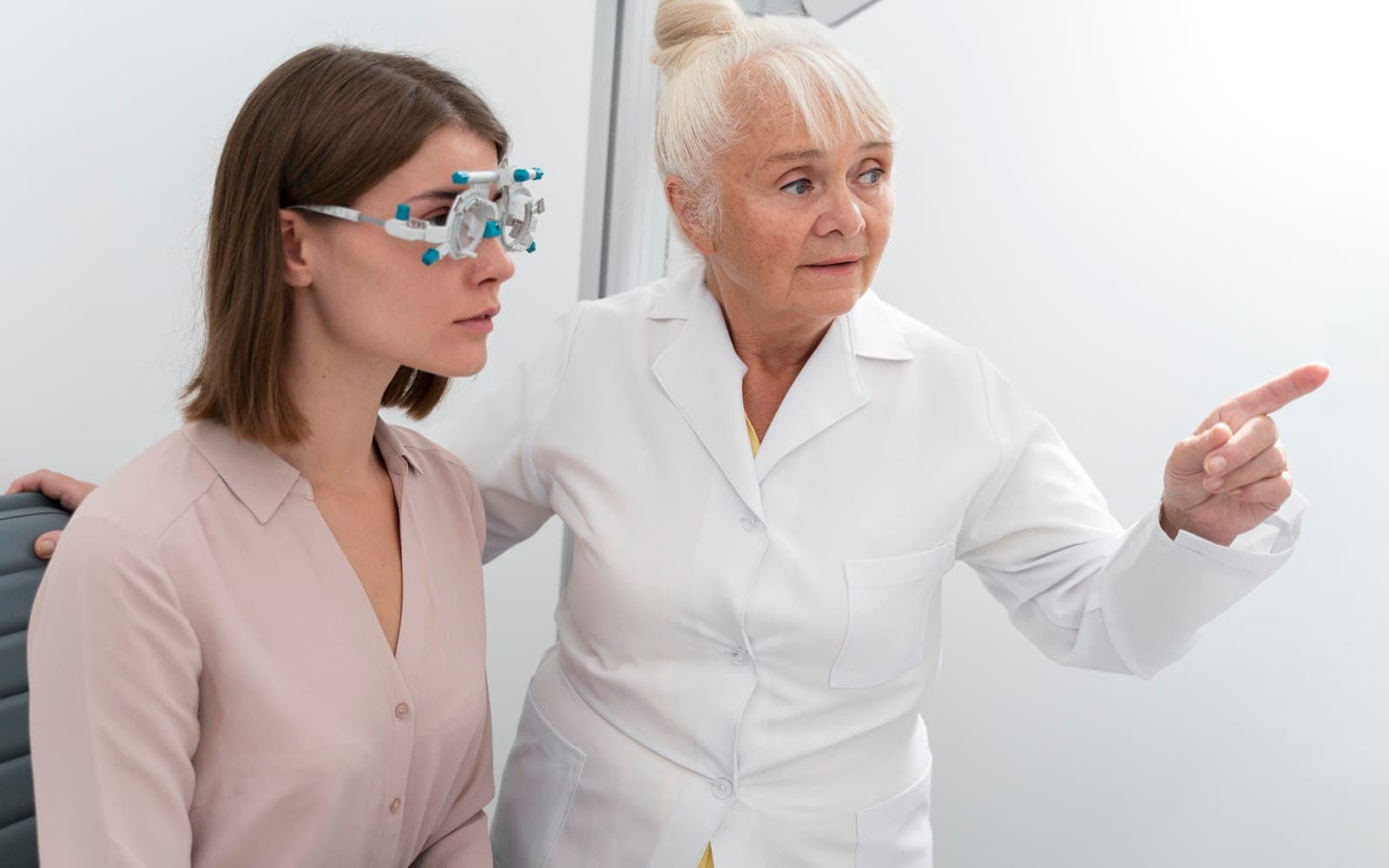
When you come with a night-driving complaint, the doctor looks not only at lens clouding but also at other factors that can affect vision. This helps to find the real cause of your symptoms and to choose the right treatment.
- Your level of vision and glasses prescription are measured.
- The clouding of the lens is examined with a special microscope.
- The ocular surface and cornea are assessed for dryness and surface irregularity.
- The back of the eye, including the retina and macula, is examined.
- You are asked whether you have had laser or other eye surgery before.
Depending on the findings, monitoring, a change of glasses, surface treatment or surgery may be suggested. Describing your symptoms and driving habits openly makes the decision easier. Legal limits and responsibilities regarding driving also apply separately, so it is wise to ask your doctor for advice on this.
The information in this article is general and does not replace a personal examination. A plan is made for you by weighing the cause of your symptoms, the overall condition of your eye, any coexisting illnesses and your expectations together. Do not hesitate to ask your doctor openly about anything that concerns you; a well-informed patient can take part in each stage of the decision more comfortably. If your symptoms change or get worse, contact your doctor without waiting for the planned review date.
Frequently Asked Questions
I see well by day but not at night. Could it be a cataract?
It could; a cataract may show up as night glare before it affects daytime vision. Other causes such as glasses prescription or dry eye are possible too, so an examination is needed.
Do special night-driving glasses help?
Yellow-tinted "night glasses" have not been shown to fix cataract-related problems. Up-to-date glasses with an anti-reflective coating may be more comfortable for some people; ask your doctor.
Will glare go away after surgery?
For many people problems caused by clouding improve, but lens-related halos can occur depending on the lens type. Expectations should be discussed before surgery.
When can I drive again after surgery?
This varies from person to person. Your doctor will decide after assessing your vision.
Scientific references
- Villa C, Gutiérrez R, Jiménez JR, et al.. Night vision disturbances after successful LASIK surgery. Br J Ophthalmol. 2007. PMID: 17314153
- Wang SY, Stem MS, Oren G, et al.. Patient-centered and visual quality outcomes of premium cataract surgery: a systematic review. Eur J Ophthalmol. 2017. PMID: 28574135